
From Copilot to Claude Code
How my AI development workflow evolved from GitHub Copilot autocomplete to multi-agent Claude Code sessions in tmux. The tools changed, and so did how I write code.
Copilot Wasn’t Enough
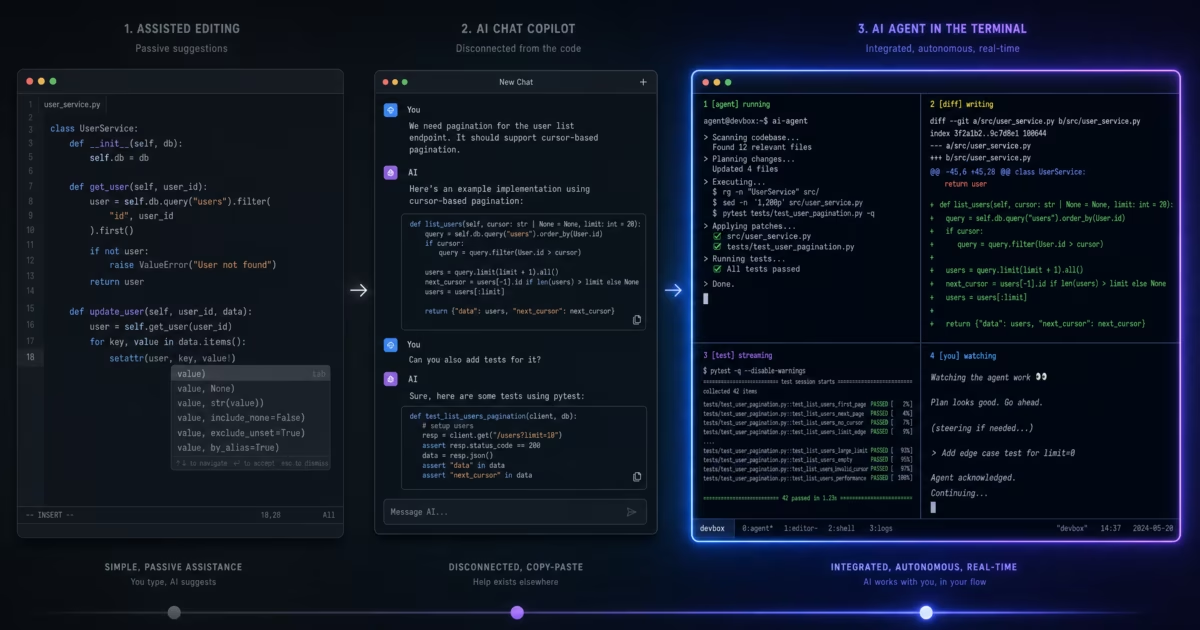
I was paying for GitHub Copilot, running it inside JetBrains via Remote Gateway on a Hetzner dev server. It was fine for autocomplete — predicting the next line, filling in boilerplate. But it didn’t understand context beyond the current file. It couldn’t reason about architecture, debug across services, or help with the kind of decisions that actually slow down development.
When I dropped JetBrains, Copilot went with it. I started using Claude through chat instead — pasting code, asking questions, getting answers. Better reasoning, but clunky. Copy-paste isn’t a workflow.
Claude Code CLI
Claude Code launched as a research preview in early 2025. I started using it immediately, running it on my Hetzner development server, where my entire codebase lived.
It was a different experience from chat. Claude could read the project, understand the structure, make changes across files. But I was working on a large enterprise codebase at the time, and the infrastructure constraints meant Claude couldn’t always access what it needed. The potential was obvious, but the environment limited what was practical.
The Neovim Shift
Around September 2025, I switched to Neovim full-time. With Claude Code already running in the terminal, the pairing was natural — tmux session with Neovim in one pane, Claude Code in another, Lazygit a keypress away. Everything in the same terminal, no context switching between applications.
Claude Code Web
In late October 2025, I got into the Claude Code Web research preview. This changed things significantly.
I was starting Dadooo.ai development around this time, and the web interface let me run multiple Claude Code instances simultaneously — each on a different branch, each working on a different part of the platform. I’d have one instance building a new domain module while another fixed bugs on the main branch. Switch between tabs, check what each instance was doing, redirect when something went off track.
This is where I thought I’d found the setup. Multiple instances, branch switching, parallel development across a complex codebase.
Then it started breaking. Conversations would slow down, crash mid-task, or lose context. I’d have to re-explain what Claude was working on after a crash. The instability turned what should have been a productivity multiplier into a babysitting job — constantly checking if the session was still alive, re-navigating Claude through context it had already seen.
Back to Terminal
Around early 2026, I moved back to the CLI. Two things made the difference:
Stability. The terminal client didn’t crash. Sessions didn’t randomly slow down. Claude would work through a task and finish it without me checking every few minutes.
Resume. When a session needed to continue later, the resume option preserved the full context. No re-explaining, no lost state. This alone was worth the switch — on the web, a crashed conversation meant starting over.
The multiplexing I’d had on the web? tmux handles it better. Multiple Claude Code instances in separate panes or windows, each in their own working directory. I can see all of them at once. Switch between them instantly. And they don’t crash.
The Current Setup
Today, even simple tasks go through Claude. Compress a PDF, convert an image to AVIF, write a migration, scaffold a new domain. It’s faster to describe what I want than to look up the ffmpeg flags or ImageMagick syntax I’ll forget by next week.
For real development work, I run multiple Claude Code instances in tmux, each focused on a different task or branch. One might be implementing a feature while another reviews a PR or investigates a bug. The multi-agent workflow that was fragile on the web is solid in the terminal.
The trajectory from Copilot to here isn’t just a tool swap. Copilot predicted the next line. Claude Code is a collaborator that understands the project. The way I write code has fundamentally changed. I spend more time thinking about architecture and reviewing output, less time typing syntax and looking up API signatures.
That’s a trade I’d make every time.
Written by
Peter KnausFounder of KnausDev. I build backend systems, AI pipelines, and enterprise platforms.